> For the complete documentation index, see [llms.txt](https://docs.spike.sh/llms.txt). Markdown versions of documentation pages are available by appending `.md` to page URLs; this page is available as [Markdown](https://docs.spike.sh/status-pages/create-status-page.md).
# Create a status page
Create a public status page in Spike to communicate the health of your website, API, or any customer-facing service.
A status page is a public-facing page that shows the current status of your system components: website, API, mobile app, or any service your customers depend on.
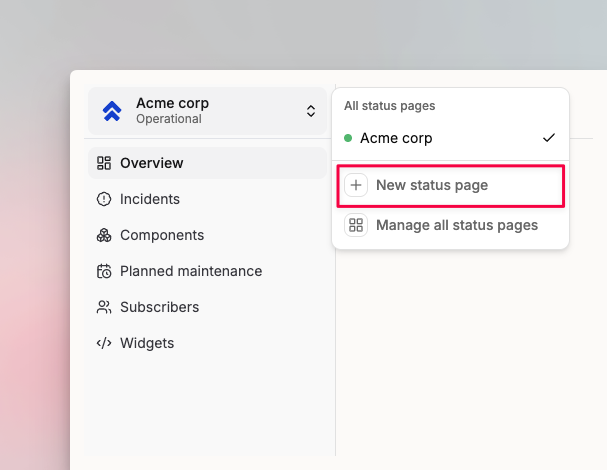
To create one, open the Status Pages dashboard and click **New status page** from the dropdown in the top navigation.
## Fill in the details
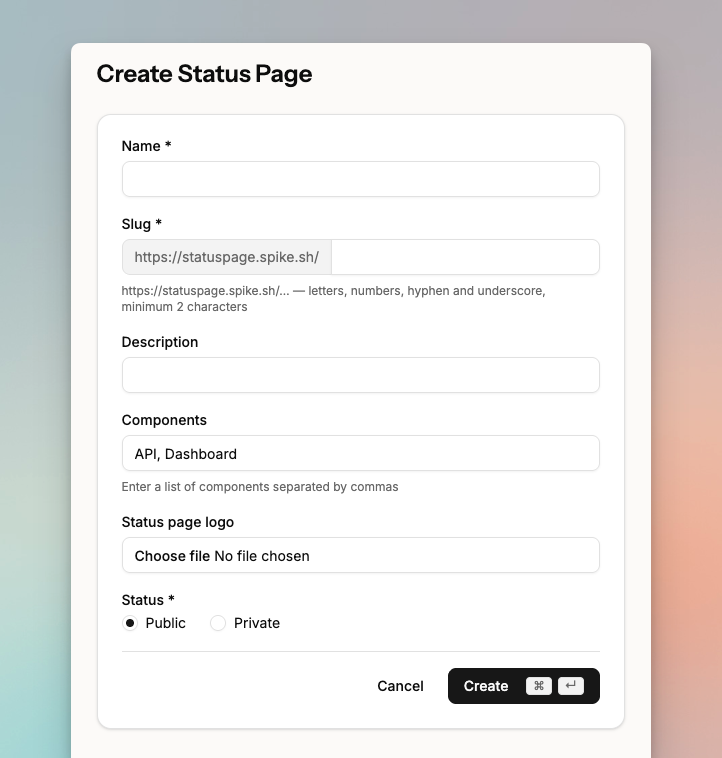
Fill in the name and description. The slug you set here becomes the URL where your status page is publicly accessible at `https://statuspage.spike.sh/your-slug`.
Upload a logo so customers can identify the page as yours.
Set the visibility to **Public** to make the page accessible to anyone with the link.
## Add components
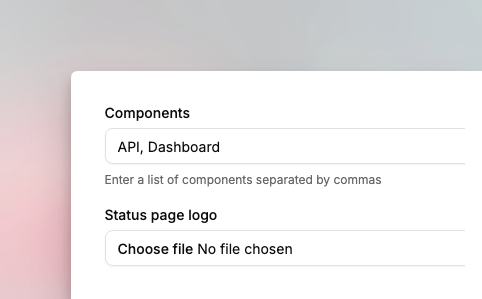
Components represent the parts of your system you want to display status for — website, API, mobile app, or individual microservices. Enter them as a comma-separated list.
Once they exist, you can [group related components under a parent](/status-pages/group-components-into-nested-components.md) to keep the list short.
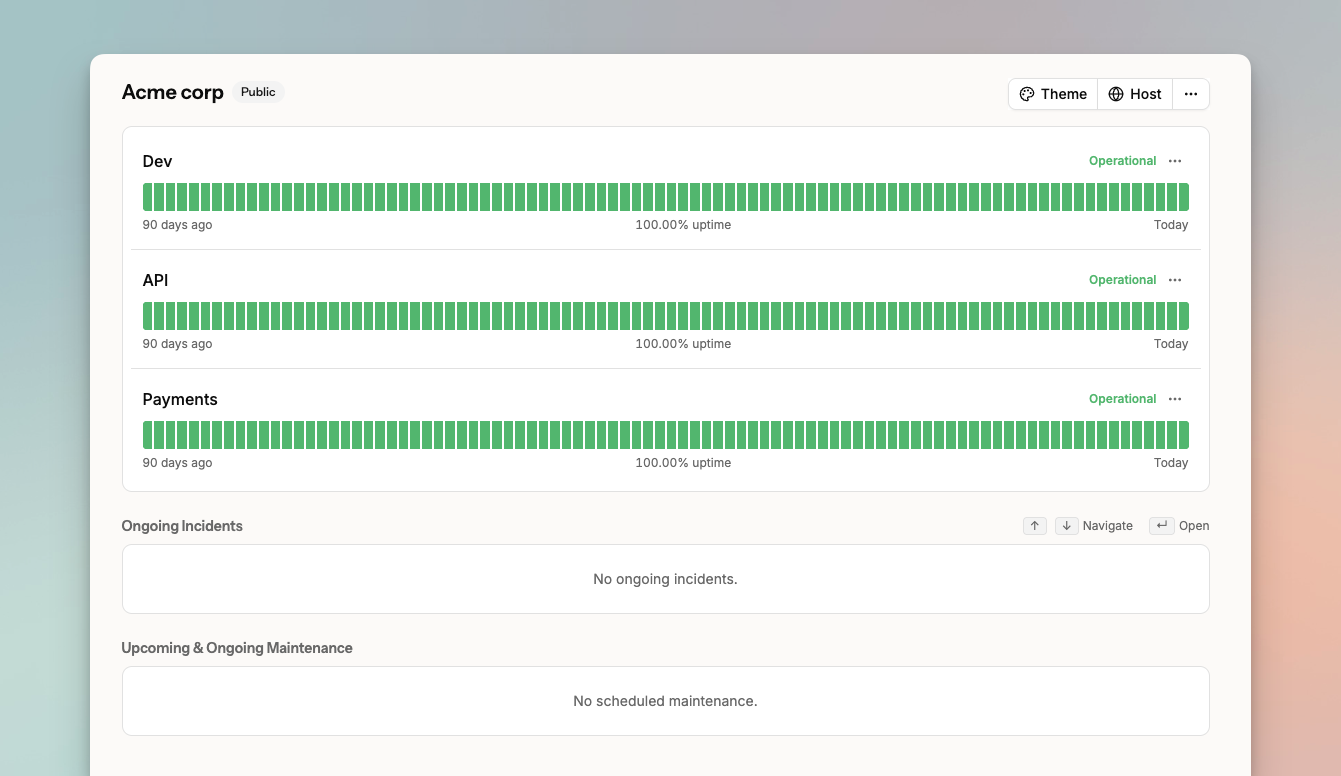
Once created, your status page appears in the dashboard with uptime history for each component.
Your status page in the dashboard.
{% hint style="info" %}
Next, [style your status page](/status-pages/style-your-status-page.md) with your brand colors, or [add a custom domain](/status-pages/add-custom-domain-to-status-page.md).
{% endhint %}
---
# Agent Instructions
This documentation is published with GitBook. GitBook is the documentation platform designed so that both humans and AI agents can read, navigate, and reason over technical content effectively. Learn more at gitbook.com.
## Querying This Documentation
If you need additional information that is not directly available in this page, you can query the documentation by asking a question.
Perform an HTTP GET request on the following URL with the `ask` and `goal` query parameters:
```
GET https://docs.spike.sh/status-pages/create-status-page.md?ask=&goal=
```
`ask` is the immediate question: it should be specific, self-contained, and written in natural language.
`goal` is what the user is ultimately trying to achieve, the reason they need the answer. Sharing it helps GitBook give you a better, more relevant answer. A goal is most helpful when it describes the outcome the user wants rather than restating the question. For example, with `ask=how do I create an API token`, a goal like `automate deployments from our CI pipeline` lets GitBook tailor the answer to that use case.
The response will contain a direct answer to the question and relevant excerpts and sources from the documentation.
Use this mechanism when the answer is not explicitly present in the current page, you need clarification or additional context, or you want to retrieve related documentation sections.